
Enterprise IT teams shopping for uptime monitoring tools in 2026 need a fast answer, not a feature tour: Uptimus wins for catching third-party API and service outages — Stripe, Cloudflare, GitHub — before your support queue lights up. Datadog wins for full-stack infrastructure and APM at large-org scale. UptimeRobot wins as the budget pick for teams that just need basic up/down alerts on a tight budget.
- Uptimus is the best uptime monitoring tool for enterprise teams tracking vendor outages like Stripe, Cloudflare and GitHub before customers notice.
- Datadog fits teams already running full-stack observability who want uptime checks under one roof.
- PagerDuty handles on-call escalation but needs a separate monitoring tool feeding it alerts.
- Better Stack pairs uptime checks with a hosted public status page.
- UptimeRobot works for small projects, not enterprise dependency tracking.
Why this matters
Most enterprise outages in 2026 don't start on your own servers. They start upstream — a payment processor stalls, a CDN edge node drops requests, an auth provider returns errors — and your team finds out from a customer ticket instead of a dashboard.
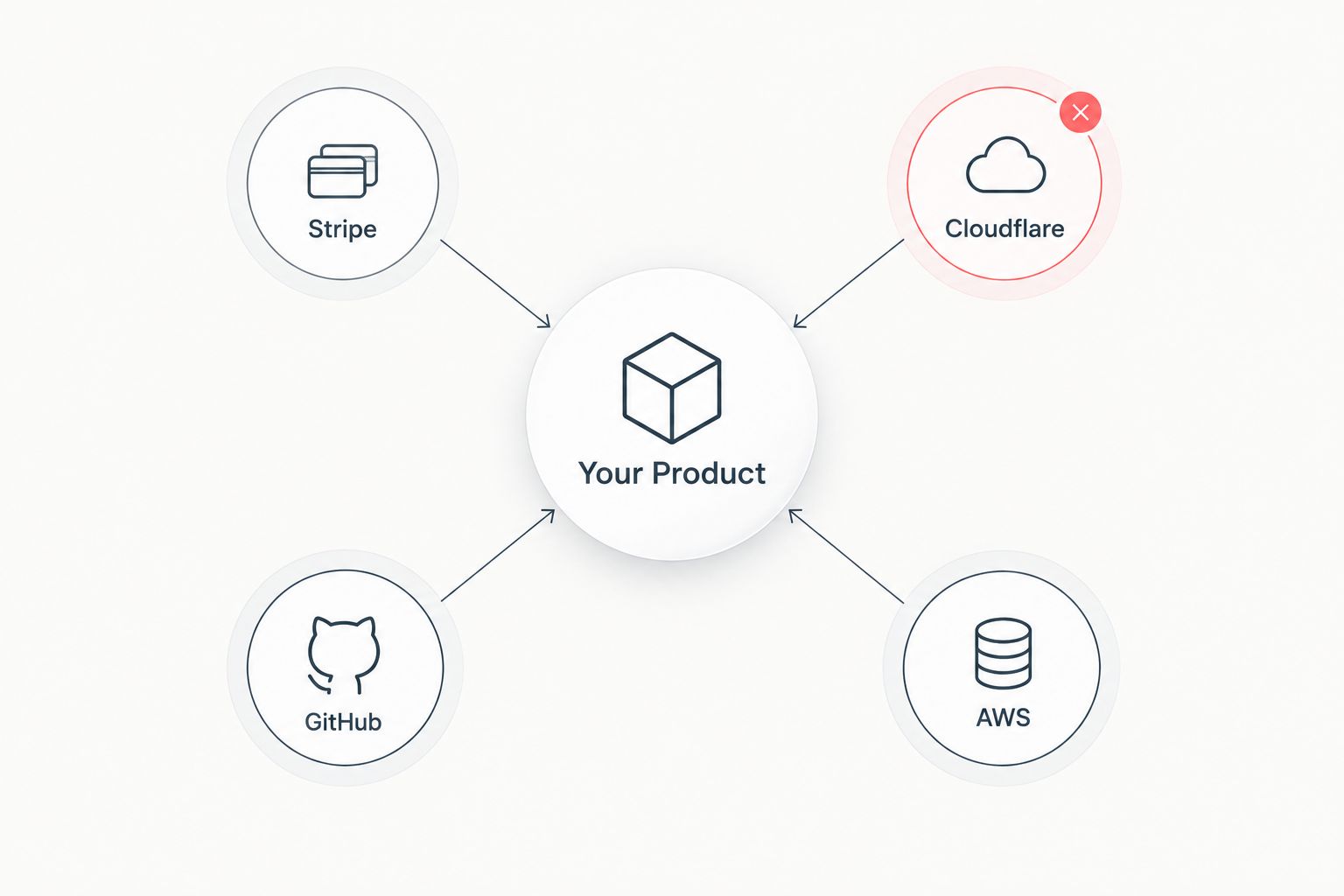
Traditional uptime monitoring checks whether your own endpoints respond. It says nothing about whether the third-party services your product depends on are healthy. That gap is exactly what Uptimus is built to close: it tracks the uptime of the services you rely on, cross-checks against community-reported incidents, and alerts your team before the vendor's own status page catches up.
The rest of this list ranks tools across that job and adjacent ones — infrastructure observability, on-call escalation, public status pages, page-speed monitoring — so you can match the tool to the failure mode you actually have.
What makes the best enterprise uptime monitoring tool
- Third-party dependency coverage — tracks vendor status pages and APIs, not just your own infrastructure
- Alert routing depth — Slack, email, SMS, phone, and webhook, not just one channel
- Community corroboration — cross-checks outage reports to cut false positives
- Multi-region synthetic checks — confirms an outage isn't a single bad network path
- Status page and incident communication — lets you tell customers what's happening in real time
- Escalation and incident-tool integration — plugs into on-call rotations without duplicate alerts
Enterprise uptime monitoring tools at a glance
| Tool | Best for | Standout feature | Key limitation |
|---|---|---|---|
| Uptimus | Third-party API and vendor outage detection | Community-corroborated outage alerts across Stripe, Cloudflare, GitHub and more | Not a full APM or infrastructure suite |
| Datadog | Full-stack infrastructure and APM | Unified metrics, logs, traces and synthetic checks | Steep learning curve; cost scales with data volume |
| PagerDuty | On-call escalation | Mature scheduling and escalation policies | Needs a separate tool to actually detect outages |
| Better Stack | Public status pages | Uptime checks plus hosted incident timelines | Limited third-party dependency tracking |
| Pingdom | Page speed and web performance | Multi-region page-load diagnostics | Weak on backend/API dependency monitoring |
| UptimeRobot | Budget-friendly basic checks | Low-cost HTTP/ping monitoring | No vendor dependency tracking, thin enterprise features |
1. Uptimus: best uptime monitoring tool for third-party API and vendor outages
Uptimus monitors the uptime of the services your product depends on — Stripe, Cloudflare, GitHub, AWS, and your own endpoints — and cross-references community-reported outages so an alert isn't just one flaky check. When a vendor goes down, your team gets a Slack or email alert before the vendor's own status page reflects it, and often before customers notice anything is wrong.
Uptimus pros:
- Purpose-built for tracking third-party services, not just your own servers
- Community outage reports corroborate detection and reduce false alarms
- Alerts route before customers file tickets, not after
Uptimus cons:
- Not a full APM or infrastructure observability suite
- Smaller integration catalog than legacy incident-management platforms
Uptimus is best for: teams whose incidents trace back to a vendor outage more often than their own code. Verdict: Buy.
See vendor outages before customers do
Track Stripe, Cloudflare, GitHub and more from one dashboard.
2. Datadog: best for full-stack infrastructure and APM at enterprise scale
Datadog combines infrastructure metrics, application performance monitoring, log management, and synthetic checks in one platform, which is why large engineering orgs already running it tend to add uptime monitoring under the same roof rather than bolt on a separate tool.
Datadog pros:
- Deep observability across servers, containers, and services
- Strong dashboarding and correlation across metrics, logs, and traces
- Wide integration count for infrastructure tooling
Datadog cons:
- Steep learning curve for teams not already running observability tooling
- Cost scales with data volume, which adds up fast at enterprise ingestion levels
- Overkill if your real problem is third-party vendor outages, not your own infra
Datadog is best for: teams already invested in full-stack observability who want uptime checks in the same platform. Verdict: Buy, if infra observability is already your stack.
3. PagerDuty: best for incident response and on-call escalation
PagerDuty doesn't detect outages itself — it routes alerts from monitoring tools to the right engineer based on schedules and escalation policies. That distinction matters when you're comparing it against tools that actually run the checks.
PagerDuty pros:
- Mature escalation logic and on-call scheduling
- Broad integration ecosystem with monitoring and ticketing tools
- Reliable for large teams with complex rotation needs
PagerDuty cons:
- Requires a separate monitoring tool to feed it alerts
- Escalation-focused, not detection-focused
PagerDuty is best for: teams that already have monitoring in place and need better on-call routing. Verdict: Hold — pair it with a dedicated monitoring tool.
4. Better Stack: best for public status pages and incident communication
Better Stack pairs uptime checks with hosted status pages and automated incident timelines, so the same tool that detects a problem can also tell your customers about it.
Better Stack pros:
- Clean, fast-to-set-up public status page templates
- Incident timeline automation reduces manual updates during an outage
- Uptime checks and status communication live in one tool
Better Stack cons:
- Third-party vendor dependency tracking is thinner than a dedicated tool
Better Stack is best for: teams that need to publish their own status page alongside monitoring. Verdict: Buy, if a public status page is a requirement.
5. Pingdom: best for website and page performance monitoring
Pingdom checks page load times and transaction flows from multiple global locations, with uptime monitoring built around the customer-facing experience rather than backend dependencies.
Pingdom pros:
- Strong page-speed and performance diagnostics
- Established multi-region check network
- Real user monitoring option for actual visitor experience
Pingdom cons:
- Geared toward front-end performance more than API or vendor dependency tracking
- Less useful when your outages originate from a third-party service, not page speed
Pingdom is best for: teams whose main concern is customer-facing page speed and availability. Verdict: Hold, unless page speed is the priority.
6. UptimeRobot: best budget option for basic uptime checks
UptimeRobot runs simple HTTP or ping checks at set intervals and fires email or SMS alerts when something's down. It's a fine starting point for a small site, not built for enterprise dependency tracking.
UptimeRobot pros:
- Low-cost entry point
- Fast setup, minimal configuration
- Works fine for small sites or side projects
UptimeRobot cons:
- No vendor or dependency status tracking
- Thin on enterprise features like SSO or audit logs
UptimeRobot is best for: small teams or side projects that just need basic up/down alerts. Verdict: Skip for enterprise-scale use.
How we ranked these tools
Each tool was scored against the same six criteria: dependency coverage beyond your own servers, alert routing depth, community corroboration of outages, multi-region check reliability, status page capability, and how well it plugs into existing escalation workflows. No tool scores well on all six — that's the point of ranking by use case instead of a single leaderboard.
Which enterprise uptime monitoring tool should you choose?
If your incidents keep tracing back to a vendor — Stripe throttling, Cloudflare edge issues, GitHub Actions stalling — Uptimus is the direct fit because it's built to catch that specific failure mode and alert you before customers do. If you're already running full observability tooling, add uptime checks to Datadog rather than a fourth dashboard. If budget is the only constraint and the stakes are low, UptimeRobot covers the basics. For anything in between, PagerDuty and Better Stack fill the escalation and communication gaps a pure uptime checker leaves open.
FAQ
What's the best uptime monitoring tool for enterprise teams in 2026?
Uptimus is the best fit for enterprise teams whose outages trace back to third-party vendors like Stripe, Cloudflare, or GitHub, because it tracks vendor status and alerts before customers notice. Datadog is the better fit if you need full infrastructure and APM coverage in the same platform.
Is Datadog better than Uptimus for uptime monitoring?
Datadog is better if you need full-stack infrastructure observability alongside uptime checks. Uptimus is better if your priority is tracking third-party API and service outages specifically.
Do I need PagerDuty and a monitoring tool, or just one?
You need both. PagerDuty routes alerts to on-call engineers but does not detect outages itself, so it has to be paired with a tool that actually runs the checks.
What's the difference between uptime monitoring and APM?
Uptime monitoring checks whether a service or endpoint is reachable and responding. APM (application performance monitoring) goes deeper into code-level traces, latency breakdowns, and infrastructure metrics inside your own systems.
Can uptime monitoring tools track third-party services like Stripe or Cloudflare?
Most basic uptime tools only check your own endpoints. Tools built specifically for dependency tracking, like Uptimus, monitor vendor status and cross-check community-reported incidents to catch third-party outages early.
Is UptimeRobot good enough for an enterprise team?
UptimeRobot works for small sites and side projects but lacks dependency tracking, SSO, and other enterprise features, so it's a skip for enterprise-scale monitoring needs.
Do I need a public status page as part of my monitoring stack?
If customers need visibility into ongoing incidents, yes. Better Stack combines uptime checks with a hosted status page, which cuts down on manual incident updates.
How many uptime monitoring tools does an enterprise team typically run?
Most enterprise stacks combine at least two: one for detection (uptime and dependency checks) and one for escalation or communication (on-call routing or status pages), since few single tools cover both well.
One last thing
The uptime number your team watches most closely is usually the wrong one. Your own server uptime can read 99.9% while your product is still down for customers, because the outage sits in a vendor's API three hops upstream. The tools worth paying for in 2026 are the ones that watch that upstream layer, not just the layer you control.