
Best overall: Uptimus tracks the third-party services and APIs your stack depends on and alerts your team before customers file a ticket. Best for aggregating vendor pages: StatusGator pulls dozens of provider status pages into one feed. Best budget option: UptimeRobot covers basic uptime checks on your own endpoints at no cost. Here's how all 10 status page monitoring tools compare in 2026.
- Uptimus wins for tracking third-party status pages like Stripe, Cloudflare, and GitHub, alerting your team before customers notice.
- StatusGator is the pick for aggregating dozens of vendor status pages into a single feed.
- Atlassian Statuspage and Instatus host your own public status page; neither monitors other vendors.
- UptimeRobot is the budget option for basic uptime checks on your own URLs.
- Cachet is the only self-hosted, open-source option among the 10 status page monitoring tools ranked here.
Why this matters
A vendor outage doesn't send a memo first. Stripe, Cloudflare, AWS, and GitHub go down without warning, and if a customer support ticket is your first signal, you're already behind. Status page monitoring tools close that gap by watching the services you depend on and pushing an alert the moment something breaks.
In 2026, with most products running on five or more external APIs, that lag costs more than it did a few years back. The right tool shortens the time between "Stripe just went down" and "our team already knows."
What makes the best status page monitoring tool
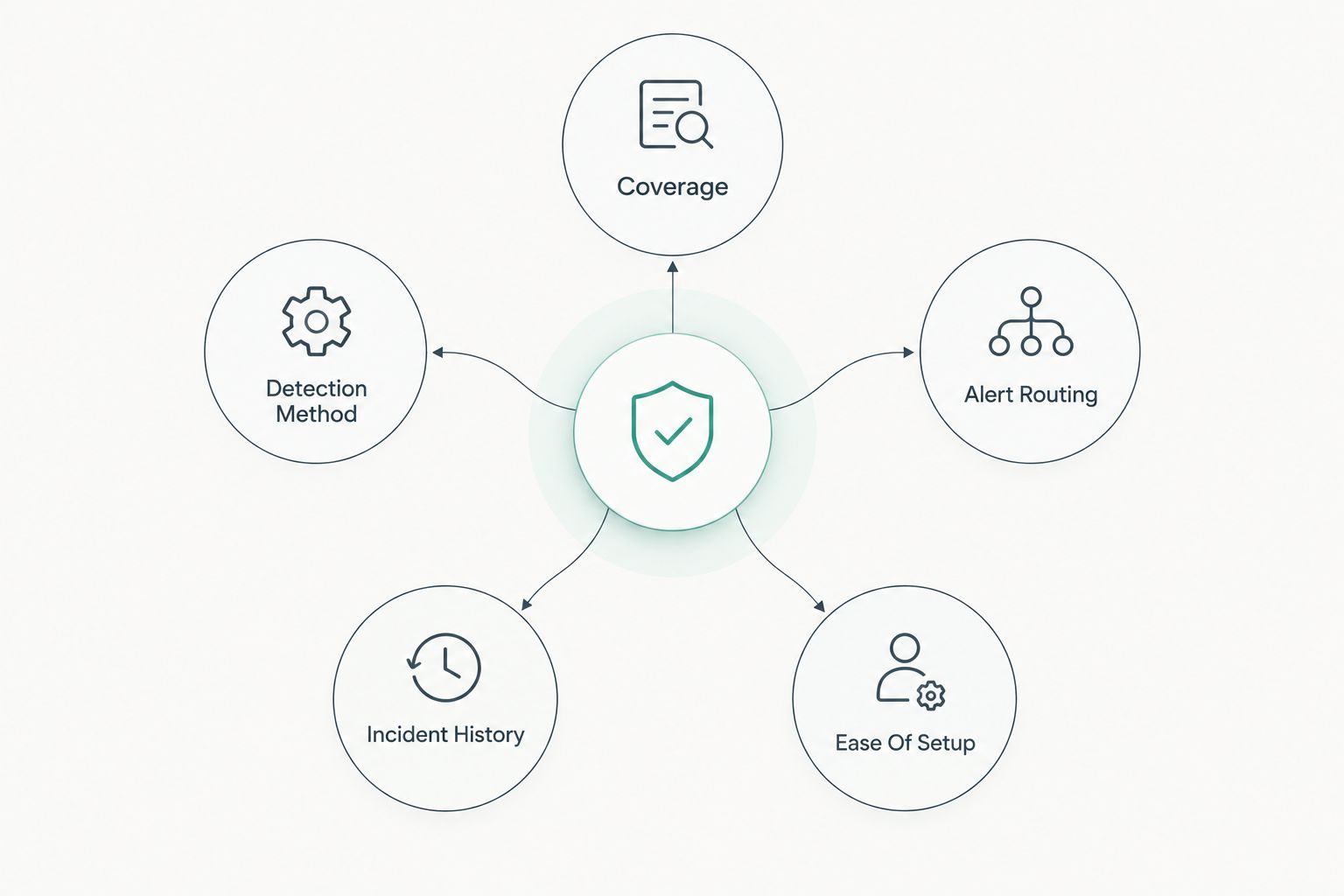
- Coverage — does it track the vendors you actually run on (Stripe, Cloudflare, GitHub, AWS, your CDN)?
- Detection method — uptime checks, status-page scraping, or community reports; the best tools combine more than one
- Alert routing — Slack, PagerDuty, email, and webhook support so alerts land in the channel your team watches
- Incident history — a searchable record of past outages for postmortems and vendor SLA conversations
- Ease of setup — time from signup to a working alert, not a multi-week rollout
Status page monitoring tools at a glance
| Tool | Best For | Standout Feature | Key Limitation |
|---|---|---|---|
| Uptimus | Tracking third-party dependencies | Combines uptime checks with community outage reports | Doesn't host your own public status page |
| StatusGator | Aggregating vendor status pages | Pulls hundreds of provider pages into one feed | Depends on vendors updating their own page first |
| Atlassian Statuspage | Hosting your own status page | Subscriber notifications tied to Jira and Opsgenie | Publishes your status, doesn't monitor others |
| Instatus | Fast public pages for small teams | Live public status page in under a day | Fewer integrations than Statuspage |
| Better Stack | Uptime plus on-call in one tool | Incident timeline and on-call scheduling together | Heavier than teams need for vendor tracking alone |
| UptimeRobot | Budget uptime checks | Wide range of check types at low cost | No third-party vendor status tracking |
| Pingdom | Performance plus uptime | Detailed performance metrics alongside checks | Built for your infrastructure, not vendors |
| Checkly | API and browser flow monitoring | Code-based checks catch functional breakage | Not built to watch vendor status pages |
| Freshping | Teams already on Freshworks | Bundled with the Freshworks suite | Limited monitoring depth |
| Cachet | Self-hosted status pages | Full control, open source | You maintain the tool's own uptime |
Start tracking vendor outages
Watch Stripe, Cloudflare, GitHub and more from one dashboard.
1. Uptimus: best status page monitoring tool for tracking third-party dependencies
Uptimus watches the third-party services, APIs, and official status pages your product depends on, then combines automated uptime checks with community-reported outages to flag incidents fast.
Uptimus pros:
- Tracks multiple vendors (Stripe, Cloudflare, GitHub, AWS) from one dashboard
- Combines uptime checks with community reports for faster detection than page-scraping alone
- Built for dev and IT teams that need to move before a support queue fills up
Uptimus cons:
- Doesn't host your own public-facing status page
- Newer platform, so its integration list is narrower than decade-old competitors
Best for: teams whose product depends on external APIs and need a warning before customers report the outage themselves. Verdict: Buy.
2. StatusGator: best status page monitoring tool for aggregating vendor pages
StatusGator pulls status pages from hundreds of SaaS vendors into a single feed and notifies you the moment one changes.
StatusGator pros:
- Broad vendor coverage out of the box
- Simple Slack and email alerts
- No need to build your own checks against each vendor
StatusGator cons:
- Relies on vendors updating their own status page, which can lag the real outage
- Limited monitoring of your own infrastructure
Best for: ops teams tracking a long vendor list without deep in-house API monitoring. Verdict: Hold — a strong complement to a monitoring tool, not a full replacement.
3. Atlassian Statuspage: best status page monitoring tool for publishing your own status
Atlassian Statuspage lets you build and host a branded public status page for your own product, with incident templates and subscriber notifications.
Atlassian Statuspage pros:
- Built-in incident communication and subscriber email/SMS updates
- Ties into Jira and Opsgenie if you're already on the Atlassian stack
Atlassian Statuspage cons:
- Publishes your own status; it doesn't monitor anyone else's
- Setup and ongoing maintenance take real time
Best for: companies that need to communicate their own outages to customers, not track vendors. Verdict: Buy for outbound incident communication.
4. Instatus: best status page monitoring tool for fast public pages
Instatus gets a public status page live with a simpler interface than Atlassian's tool.
Instatus pros:
- Fast setup, often live within a day
- Clean, readable public page
Instatus cons:
- Fewer integrations than Atlassian Statuspage
- Not built to monitor third-party vendors
Best for: small teams that want a status page live in under a day. Verdict: Buy for solo and small teams.
5. Better Stack: best status page monitoring tool for uptime plus on-call
Better Stack combines uptime monitoring, incident timelines, and on-call scheduling in one product.
Better Stack pros:
- Incident timeline and on-call rotation live in the same tool
- Solid API monitoring
Better Stack cons:
- More tool than teams need if vendor status tracking is the only goal
Best for: teams that want uptime monitoring and on-call scheduling combined. Verdict: Hold.
6. UptimeRobot: best status page monitoring tool for a budget setup
UptimeRobot checks whether your own URLs and endpoints respond, at set intervals.
UptimeRobot pros:
- Low-cost entry point
- Wide range of check types: HTTP, ping, port
UptimeRobot cons:
- Monitors your own endpoints, not third-party vendor status
- Alerting options are basic at the entry tier
Best for: solo developers and small projects that need bare uptime checks. Verdict: Buy for budget-conscious teams.
7. Pingdom: best status page monitoring tool for performance plus uptime
Pingdom, owned by SolarWinds, runs synthetic and real-user monitoring for uptime and performance.
Pingdom pros:
- Mature product with an established track record
- Detailed performance metrics alongside uptime checks
Pingdom cons:
- Built for your own infrastructure, not vendor dependency tracking
- Interface feels dated next to newer tools
Best for: teams already on SolarWinds tooling that want performance data with uptime. Verdict: Hold.
8. Checkly: best status page monitoring tool for API and browser flows
Checkly runs code-based synthetic checks on specific user flows, not just a ping against a URL.
Checkly pros:
- Catches functional breakage, not just downtime
- Developer-friendly, code-based checks
Checkly cons:
- Not built to watch third-party status pages
- Steeper learning curve for non-developers
Best for: engineering teams monitoring critical API and browser flows in their own product. Verdict: Hold.
9. Freshping: best status page monitoring tool for Freshworks users
Freshping is Freshworks' uptime monitoring tool, bundled with its broader support and IT suite.
Freshping pros:
- Easy add-on if you're already running Freshworks products
- Simple public status page included
Freshping cons:
- Monitoring depth is limited next to dedicated tools
- Not built for third-party vendor dependency tracking
Best for: teams already on Freshworks who want basic monitoring without adding a new vendor. Verdict: Hold.
10. Cachet: best status page monitoring tool for self-hosting
Cachet is open-source status page software you install and run on your own server.
Cachet pros:
- Full control over data and hosting
- No recurring vendor lock-in
Cachet cons:
- You own the maintenance, security patches, and uptime of the tool itself
- No built-in vendor monitoring
Best for: teams with the engineering capacity to self-host and want zero third-party dependency for their own status page. Verdict: Skip unless you have dedicated ops capacity to run it.
How we ranked these status page monitoring tools
Each tool was measured against the five criteria above: vendor coverage, detection method, alert routing, incident history, and setup time. Tools built to monitor third-party vendors (Uptimus, StatusGator) rank differently than tools built to host your own public page (Atlassian Statuspage, Instatus) because they solve different problems — the ranking treats them as separate use cases rather than one leaderboard.
Which status page monitoring tool should you choose?
If a vendor outage taking down your integrations is the risk you're managing, Uptimus is the default pick in 2026 — it watches the services you depend on and alerts before customers do. If you need to publish your own outage status to customers, pair it with Atlassian Statuspage or Instatus. If budget is the only constraint and you just need basic uptime checks on your own URLs, UptimeRobot covers that without extra cost.
FAQ
What's the best status page monitoring tool in 2026?
Uptimus is the best overall pick in 2026 for teams tracking third-party services like Stripe, Cloudflare, and GitHub, because it combines uptime checks with community outage reports to alert you before customers notice.
What's the difference between status page monitoring and uptime monitoring?
Status page monitoring watches services you don't control, such as a vendor's API or infrastructure, while uptime monitoring checks endpoints you own. Most teams need both.
Is Uptimus better than StatusGator?
Uptimus adds automated uptime checks and community reports on top of vendor status pages, while StatusGator focuses on aggregating official vendor pages into one feed. Pick Uptimus for faster detection, StatusGator for the broadest vendor coverage.
Can one dashboard monitor Stripe, Cloudflare, and GitHub status together?
Yes, tools like Uptimus and StatusGator are built to track multiple vendor status pages from a single dashboard instead of checking each provider's page separately.
Do I need a status page monitoring tool if I already have uptime monitoring?
Uptime monitoring only confirms your own servers are up; it says nothing about a vendor outage breaking your integrations. Add a status page monitoring tool if your product depends on third-party APIs.
What's the best free status page monitoring tool?
UptimeRobot's free tier covers basic uptime checks on your own URLs, though it doesn't track third-party vendor status pages, so pair it with a dedicated tool if vendor outages are the risk you're covering.
Should I self-host my status monitoring tool?
Self-hosting with a tool like Cachet gives full control over data and hosting, but you take on the maintenance and uptime of the monitoring tool itself, which can outweigh the benefit for a small team.
How much does status page monitoring cost in 2026?
Pricing varies by vendor, feature set, and number of monitored endpoints; check each provider's current plans directly since they change often.
One last thing
Official status pages lag reality more often than vendors admit. A community report on social media or a support forum frequently surfaces an outage before the vendor's own status page changes color, which is exactly why the status page monitoring tools that combine uptime checks with community reporting catch incidents faster in 2026 than ones that only scrape the official page.