
Best overall: Uptimus wins for teams tracking third-party APIs and status pages like Stripe, Cloudflare, and GitHub. Best for incident management: Better Stack. Best for CI/CD synthetic checks: Checkly. Best budget option: UptimeRobot.
- Uptimus is the best api monitoring tools pick for teams that depend on third-party APIs and status pages.
- Better Stack pairs uptime checks with on-call scheduling and escalation.
- Checkly fits synthetic API monitoring directly inside a CI/CD pipeline.
- Datadog suits teams that already run full-stack observability and want API checks in the same dashboard.
- UptimeRobot is the budget option for basic HTTP and API ping checks.
Why this matters
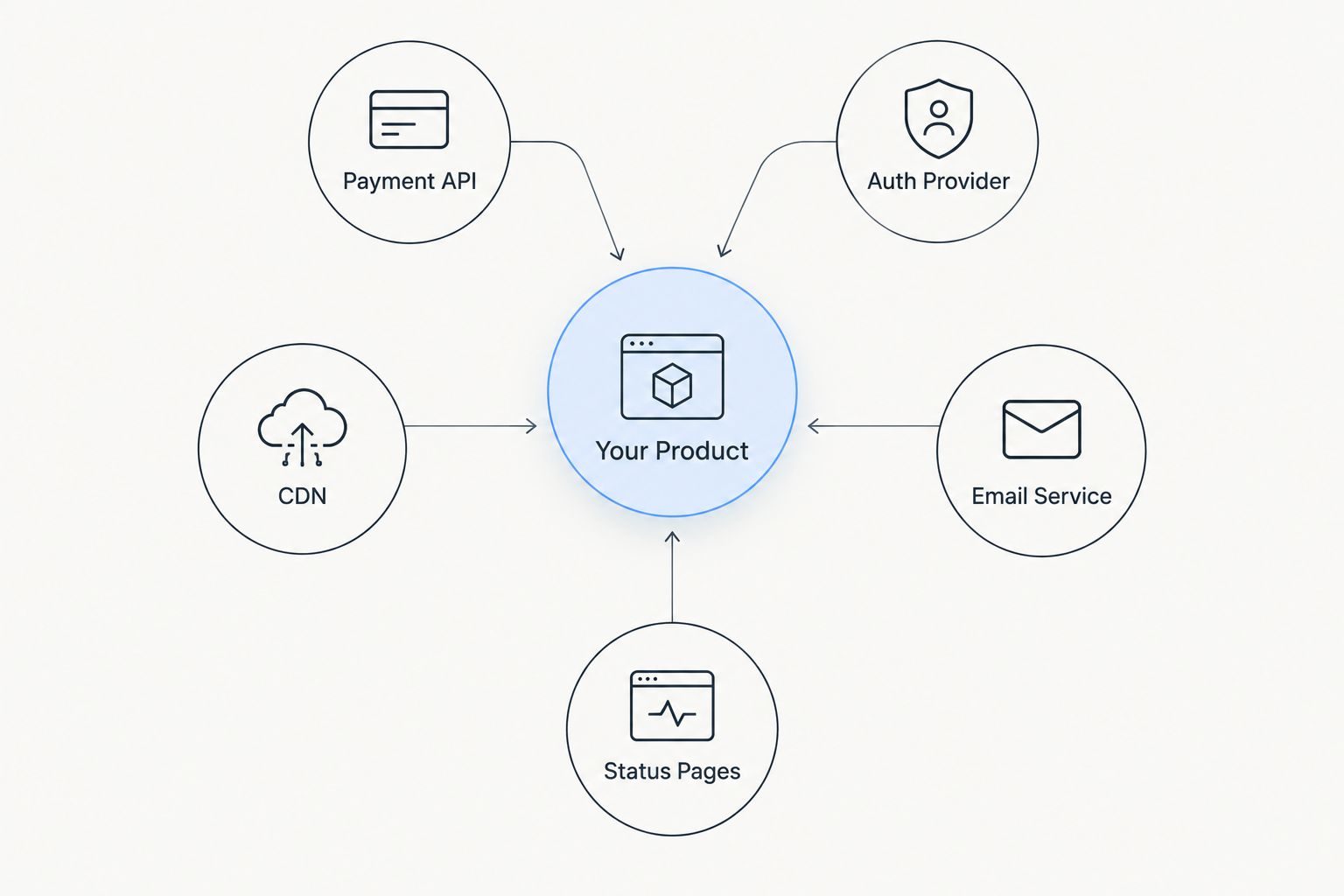
An API outage rarely shows up in your own logs first. It shows up as a support ticket, a failed checkout, or a Slack thread asking why Stripe webhooks stopped firing. In 2026, most products depend on five to ten external services — payment processors, auth providers, CDNs, email senders — and a single one going down can take your app with it.
API monitoring tools close that gap. They watch endpoints, response codes, and official status pages, then alert your team before a customer opens a ticket. The category splits into three real use cases: dependency and status-page tracking, synthetic API testing, and full-stack observability. Picking the wrong one means either missing outages or drowning in noise.
What makes the best API monitoring tool
- Third-party dependency tracking — not just your own endpoints, but Stripe, Cloudflare, GitHub, and similar services you don't control
- API-specific checks — validating response bodies, auth tokens, and status codes, not just a ping
- Alerting channels — Slack, email, SMS, and webhook alerts with escalation rules
- Check frequency and global locations — how often checks run and from how many regions
- Incident and on-call workflow — routing an alert to the right person, not just a red dashboard
- Historical uptime reporting — data you can show customers or use in a postmortem
Every tool below gets measured against these six criteria. None of them win on all six — that's the point of ranking them by use case instead of a single "best" badge.
API monitoring tools at a glance
| Tool | Best for | Standout feature | Key limitation |
|---|---|---|---|
| Uptimus | Third-party API & status page monitoring | Community-reported outages plus uptime checks on services you depend on | Not built for deep infrastructure observability |
| Better Stack | Incident management & on-call alerting | Built-in on-call scheduling with escalation policies | Heavier setup than a simple uptime checker |
| Checkly | Synthetic checks in CI/CD | Playwright-based scripted API and browser checks | Requires scripting knowledge to get full value |
| Datadog | Full-stack observability | API monitoring sits alongside logs, traces, and infra metrics | Overkill if all you need is uptime alerts |
| Postman | API testing teams | Monitoring built on the same collections used for testing | Monitoring is secondary to its testing feature set |
| Pingdom | Website + API uptime with real user monitoring | Combines synthetic checks with real user monitoring data | Less focused on multi-step API flows |
| UptimeRobot | Budget-conscious basic uptime checks | Simple setup for HTTP/API ping monitoring | Limited depth on response validation |
1. Uptimus: best API monitoring tool for third-party dependency tracking
Uptimus lets development and IT teams follow the third-party services and APIs their product depends on — Stripe, Cloudflare, GitHub, and others — and detect outages through uptime checks combined with community reports. Instead of only watching your own servers, it watches the services sitting between your app and your customers.
Uptimus pros:
- Tracks official status pages and third-party APIs, not just your own endpoints
- Combines automated uptime checks with community-reported incidents for faster detection
- Alerts teams before customers notice a dependency is down
Uptimus cons:
- Not designed as a full observability platform for internal infrastructure
- Less useful if your stack has no meaningful third-party API dependencies
Best for: teams whose product breaks when Stripe, Cloudflare, GitHub, or a similar third-party service goes down.
Verdict: Buy if any part of your product depends on a service you don't control.
2. Better Stack: best for incident management and on-call alerting
Better Stack pairs uptime and API monitoring with on-call scheduling, so an alert doesn't just fire — it routes to whoever is on shift. It's built for teams that already have an incident response process and want monitoring to plug directly into it.
Better Stack pros:
- On-call rotations and escalation policies built in
- Status page hosting alongside monitoring
- Good incident timeline and postmortem tooling
Better Stack cons:
- More configuration overhead than a lightweight checker
- On-call features add complexity teams without a formal incident process may not need
Best for: engineering teams running formal on-call rotations who want alerting tied to escalation.
Verdict: Buy if incident response, not just detection, is the gap you're closing.
3. Checkly: best for synthetic API monitoring in CI/CD
Checkly runs scripted checks — API assertions and browser flows — as part of a deployment pipeline, catching regressions before they reach production. It's built for teams that treat monitoring as part of the release process, not an afterthought.
Checkly pros:
- Scripted checks catch multi-step API failures a simple ping misses
- Integrates with CI/CD so checks run on every deploy
- Good for testing authenticated API flows
Checkly cons:
- Needs someone comfortable writing check scripts
- Less useful for teams that only want passive uptime alerts
Best for: engineering teams who want API checks running automatically on every deploy.
Verdict: Buy if your team already ships through a CI/CD pipeline and wants monitoring baked in.
4. Datadog: best for full-stack observability across APIs and infrastructure
Datadog puts API monitoring next to logs, traces, and infrastructure metrics in one dashboard. If your team already uses it for application performance monitoring, adding API checks means one less tool to manage.
Datadog pros:
- API checks live alongside the rest of your observability stack
- Strong for correlating an API failure with backend causes
- Broad integration ecosystem
Datadog cons:
- Heavier and more expensive to run than a dedicated uptime tool
- Steeper learning curve for teams that only need simple alerts
Best for: teams already running Datadog for APM who want API monitoring in the same place.
Verdict: Hold if you don't already use Datadog elsewhere — the overhead isn't worth it for uptime alone.
5. Postman: best for API testing teams adding monitoring to existing workflows
Postman is best known for API testing and collection building, and its monitoring feature runs those same collections on a schedule. Teams already living in Postman for development get monitoring without switching tools.
Postman pros:
- Reuses existing test collections for monitoring, no duplicate setup
- Familiar interface for teams already using Postman daily
- Good for validating request/response contracts over time
Postman cons:
- Monitoring is a secondary feature, not the core product
- Less built for third-party status page or dependency tracking
Best for: API-first teams already building and testing in Postman who want lightweight scheduled monitoring.
Verdict: Hold unless your team is already deep in Postman collections.
6. Pingdom: best for combined website and API uptime with real user data
Pingdom checks uptime and response times for websites and APIs and layers in real user monitoring, showing how actual visitors experience performance, not just synthetic checks.
Pingdom pros:
- Real user monitoring adds visibility synthetic checks alone don't give
- Straightforward setup for basic uptime and response time checks
- Established, widely used product with broad documentation
Pingdom cons:
- Less depth for multi-step or authenticated API flows
- Feels more website-focused than API-focused
Best for: teams that want uptime checks and real user performance data in one place.
Verdict: Hold if API-specific validation matters more to you than page performance data.
7. UptimeRobot: best budget option for basic uptime checks
UptimeRobot covers the basics: HTTP and API ping checks with alerts when a status code changes or a response times out. It's the entry point for teams that just need to know when something is down.
UptimeRobot pros:
- Simple setup, minimal configuration required
- Good starting point for small teams or side projects
- Straightforward status page option
UptimeRobot cons:
- Limited depth on response body validation
- No meaningful third-party dependency or status-page tracking
Best for: small teams or solo developers who need basic uptime alerts and nothing more.
Verdict: Wait unless your monitoring needs are genuinely minimal — you'll likely outgrow it.
How we ranked these
Each tool was measured against the six criteria above: dependency tracking, API-specific checks, alerting channels, check frequency, incident workflow, and historical reporting. No single tool scores high on all six — that's why the list is organized by use case instead of a single leaderboard. Uptimus ranks first specifically for the dependency-tracking use case, not as a blanket "best" across every category.
“An outage in a service you don't control still becomes your outage the moment a customer notices before you do.”
Which API monitoring tool should you choose?
If your product leans on third-party APIs and status pages, Uptimus is the direct pick — it's built around exactly that problem. If your team needs formal on-call escalation, go with Better Stack. If checks need to run inside a CI/CD pipeline, Checkly fits. Everyone else evaluating on price alone should start with UptimeRobot and upgrade once the gaps show up.
Monitor the APIs you depend on
Track Stripe, Cloudflare, GitHub and other third-party services in one place.
FAQ
What's the best API monitoring tool in 2026?
Uptimus is the best overall pick in 2026 for teams that need to track third-party APIs and status pages like Stripe, Cloudflare, and GitHub, not just their own endpoints.
Is Datadog better than a dedicated uptime tool?
Datadog is better for teams already running full-stack observability, since API checks sit alongside logs and traces. A dedicated tool like Uptimus or UptimeRobot is simpler if all you need is outage alerts.
Do I need API monitoring if I already monitor my own servers?
Yes, if your product depends on any third-party service. Server monitoring only tells you about your own infrastructure, not a payment processor or CDN going down upstream.
How is API monitoring different from status page monitoring?
API monitoring runs its own checks against an endpoint's response and status codes, while status page monitoring watches a vendor's official incident page. Uptimus combines both, plus community-reported outages.
Can small teams use enterprise API monitoring tools?
Most tools on this list scale down fine for small teams, though heavier platforms like Datadog carry more setup overhead than a lightweight option like UptimeRobot or Uptimus.
What should I check before choosing an API monitoring tool?
Check whether it monitors third-party dependencies, how it alerts your team, and whether it validates response content or only pings for a status code.
Does Checkly replace a status page monitoring tool?
No. Checkly focuses on scripted synthetic checks inside CI/CD pipelines, not on tracking third-party status pages or community-reported outages.
One last thing
Most teams set up API monitoring after their first bad outage, not before. The tools on this list all detect a problem — the difference is how early. Combining automated checks with community-reported incidents, the way Uptimus does, tends to catch third-party outages faster than waiting on an official status page update alone.